
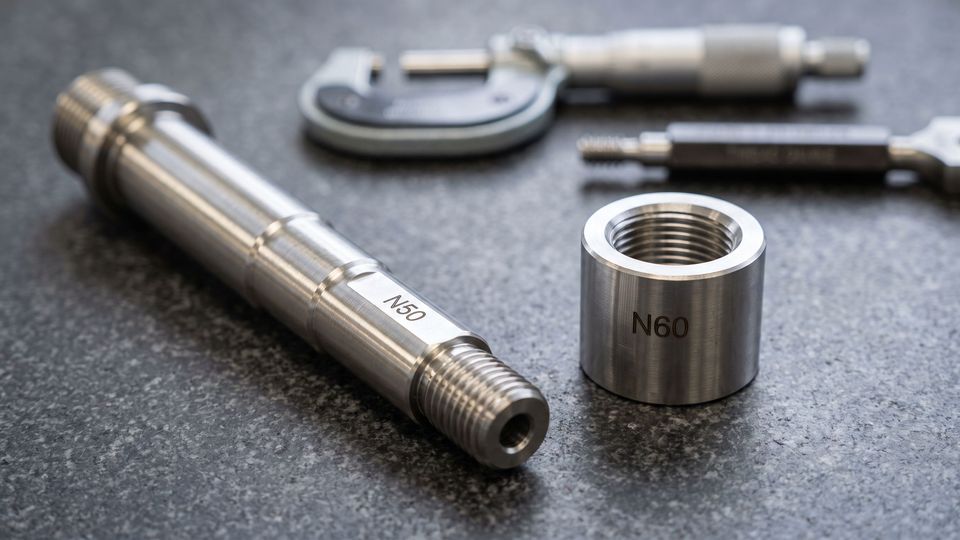
Nitronic 50 is the strength and corrosion grade. Nitronic 60 is the anti-galling grade.
Choose 50 for shafts, fasteners and fittings that sit in seawater and must not corrode, and choose 60 where metal slides on metal under load, such as valve stems, seats and threads that must not seize.
One of the most common misconceptions about Nitronic 50 is that it solves galling. The mill’s own test data says otherwise, and getting this wrong is an expensive way to find out.
We machine Nitronic 50 for subsea, marine and oil and gas customers at our Nitronic 50 machining workshop in Leighton Buzzard. This comparison uses the published AK Steel data for both alloys, so every number here can be checked.
The Quick Comparison
| Nitronic 50 | Nitronic 60 | |
|---|---|---|
| Designation | UNS S20910, XM-19 | UNS S21800 |
| Key alloying (wt %) | 20.5 to 23.5 Cr, 11.5 to 13.5 Ni, 4 to 6 Mn, 1.5 to 3 Mo, 0.15 to 0.45 N | 16 to 17 Cr, 8 to 8.5 Ni, 7.5 to 8.5 Mn, 3.7 to 4.2 Si, 0.10 to 0.18 N |
| Typical annealed tensile / yield | 827 / 414 MPa (25mm bar) | 710 / 414 MPa |
| High-strength bar | 800 MPa minimum yield up to 50.8mm | High-strength shafting available |
| Corrosion resistance | Better than 316 and 317 | Better than 304, pitting better than 316 |
| Galling against Stellite 21 | Galled at 14 MPa | No galling at 297 MPa |
| Self-mated wear (mg per 1,000 cycles) | 9.95 | 2.79 |
| Magnetic after cold work | No | Check the certificate if it matters |
| Typical parts | Pump and boat shafts, fasteners, fittings, marine hardware | Valve stems, seats and trim, nuts and bolts, pins, bushes, wear rings |
Sources for the table are the AK Steel product data bulletins for each alloy, which publish the composition, mechanical, galling and wear data.
Galling, the Difference That Decides It
Galling is adhesive wear. Two metal surfaces sliding under load weld together at high points, then tear apart, and the damage spreads until a thread seizes or a valve stem scores and leaks.
It is the classic failure of stainless steel on stainless steel. Austenitic grades like 304 and 316 are soft, sticky and form a thin oxide layer that is easily wiped away, so they gall readily against themselves.
What the Test Data Shows
AK Steel ranks alloys with a button and block test. A polished button is rotated under a dead load against a polished block, and the threshold galling stress is the load at which tearing first appears.
The results are stark:
- 316 against 316: galled at 14 MPa (2 ksi).
- 304 against 304: galled at 14 MPa.
- Nitronic 60 against Nitronic 60: galled only at 345 MPa (50 ksi).
- Nitronic 60 against 316: no galling until 262 MPa (38 ksi).
- Nitronic 50 against Stellite 21: galled at 14 MPa.
- Nitronic 60 against Stellite 21: did not gall at 297 MPa (43 ksi).
- Nitronic 50 against Monel K-500: galled at 14 MPa, where Nitronic 60 held to 117 MPa.
Against those counterparts, Nitronic 50 performs no better than 316. Nitronic 60 is in a different league, and the self-mated wear figures tell the same story, at 2.79 mg per 1,000 cycles against 9.95 for Nitronic 50 and 12.5 for 316.
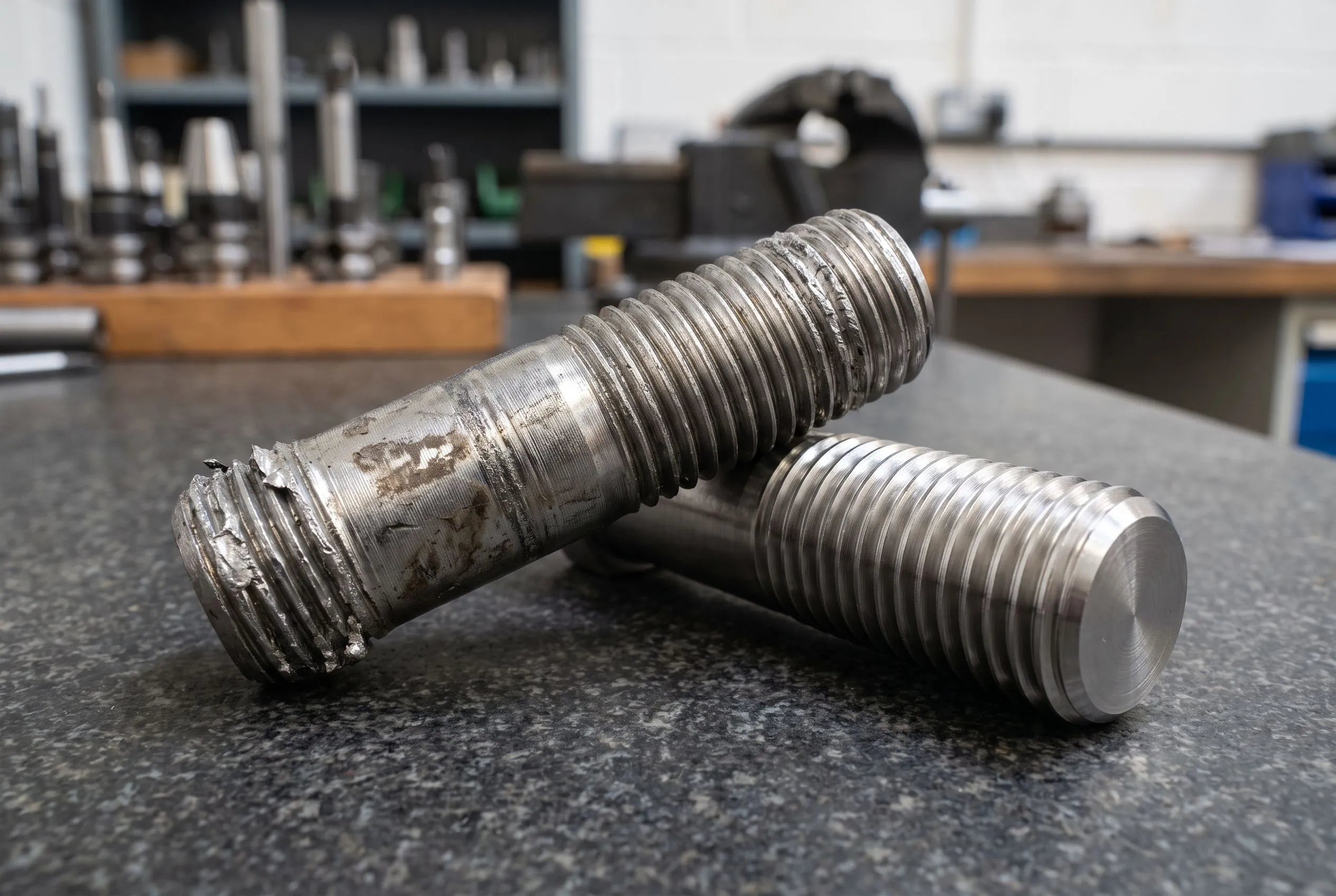
The full tables are in the Nitronic 60 product data bulletin. AK Steel is clear that the test is for screening alloys before service trials, not for design calculations, so treat the numbers as a ranking.
You Do Not Need Both Parts in Nitronic 60
This is the most useful line in the data. Nitronic 60 against Nitronic 50 did not gall at 345 MPa, the top of the test.
That means a Nitronic 50 shaft or body can run against a Nitronic 60 nut, bush or seat. You keep the corrosion resistance and strength where the part is exposed, and put the anti-galling grade only where the sliding happens.
Strength and Corrosion, Where Nitronic 50 Wins
Nitronic 50 carries more chromium, more nickel and 1.5 to 3% molybdenum. That gives it corrosion resistance better than 316, 316L, 317 and 317L, which is why it is specified for seawater-wetted shafts, fasteners and fittings.
Nitronic 60 has almost no molybdenum. Its general corrosion resistance beats 304 and its chloride pitting resistance beats 316, but for long-term immersion in seawater or aggressive chloride process fluids, Nitronic 50 is the safer choice.
Strength
Both grades have roughly twice the annealed yield strength of 316, at around 414 MPa typical. Nitronic 50 goes further in the high-strength (HS) condition, where bar up to 50.8mm diameter carries a minimum yield of 800 MPa.
HS strength comes from mill processing, not heat treatment. Welding, brazing or hot forging an HS part throws that strength away, so HS Nitronic 50 parts are machined to finished size and left alone.
Non-Magnetic and Sour Service
Nitronic 50 stays non-magnetic after cold working and at sub-zero temperatures, where 304 and 316 can pick up magnetism. That matters for naval, instrumentation and some subsea equipment.
It is also listed in NACE MR0175 / ISO 15156 for sour oil and gas service. Not every condition complies, because the standard caps hardness at 35 HRC, so check the condition against the specification before ordering bar.
If chloride strength is the main requirement and galling is not, super duplex is the other material worth comparing.
Machining Nitronic 50 and 60
Both alloys are nitrogen-strengthened austenitic stainless steels, and they machine like a tougher, stickier 316. Expect slower cutting speeds, more spindle power and faster work hardening than any 300 series grade.
The disciplines are the ones we apply to every work-hardening alloy:
- Keep the tool cutting. A tool that dwells or rubs hardens the surface, and the next pass struggles. Constant feed and positive engagement matter more than speed.
- Sharp, coated carbide. Positive-rake inserts with a sharp edge, changed before they dull, not after.
- Rigid setups. Short overhangs and secure workholding stop chatter, which these alloys punish quickly.
- Flood coolant. Heat at the cutting edge is the enemy, as it is with nickel alloys.
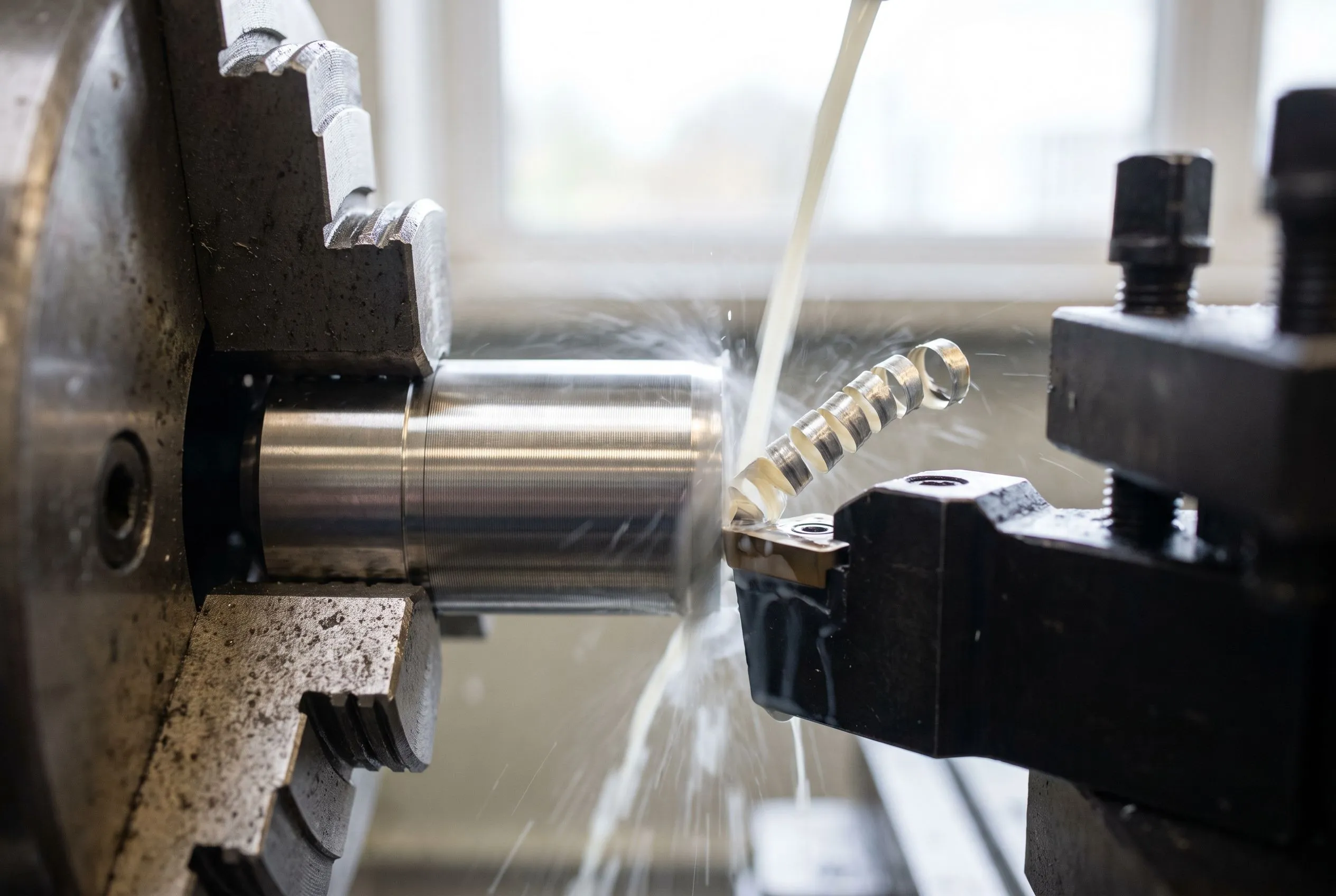
Nitronic 60’s mill bulletin is frank that it is not an easy alloy to machine. HS Nitronic 50 is harder again, at around 28 to 32 HRC against roughly 98 HRB for annealed bar.
Most Nitronic parts are round, so the bulk of this work runs on our CNC turning centres with live tooling for cross holes and flats.
Threads deserve care in both grades. Thread milling is usually safer than tapping internal threads, because a tap that loads up and stalls in a work-hardening alloy is hard to recover without scrapping the part.
Cost and Availability
Nitronic 60 contains less nickel than Nitronic 50, at 8 to 8.5% against 11.5 to 13.5%, and almost no molybdenum. On composition alone it should cost less per kilogram, and the mill positions it as a lower cost alternative to cobalt and high-nickel wear alloys such as Stellite.
In practice, neither is a commodity grade in the UK. Price and lead time depend mostly on bar size and condition, so for small batches the size you need matters more than the alloy, and machining time is similar between the two.
Which One Should You Specify?
Five questions settle it for most parts.
- Is the part wetted by seawater or chlorides and carrying load? Nitronic 50.
- Does metal slide on metal under load, or must a thread never seize? Nitronic 60.
- Do you need both? Nitronic 50 for the exposed part and Nitronic 60 for the mating nut, bush or seat.
- Must it stay non-magnetic after cold work? Nitronic 50.
- Is it for sour service? Check the condition and hardness against NACE MR0175 before ordering.
If loads are light and galling is not a risk, ordinary 316 may be enough, and our comparison of 304 vs 316 stainless steel covers that decision.
Getting Nitronic Parts Machined
Send us your drawings with the operating environment and what the part runs against. We will check the grade and condition suit the duty before quoting, and flag where a Nitronic 50 and 60 pairing would solve a galling problem.
Every part is machined from certified bar with full material traceability and CMM inspection on critical dimensions.