
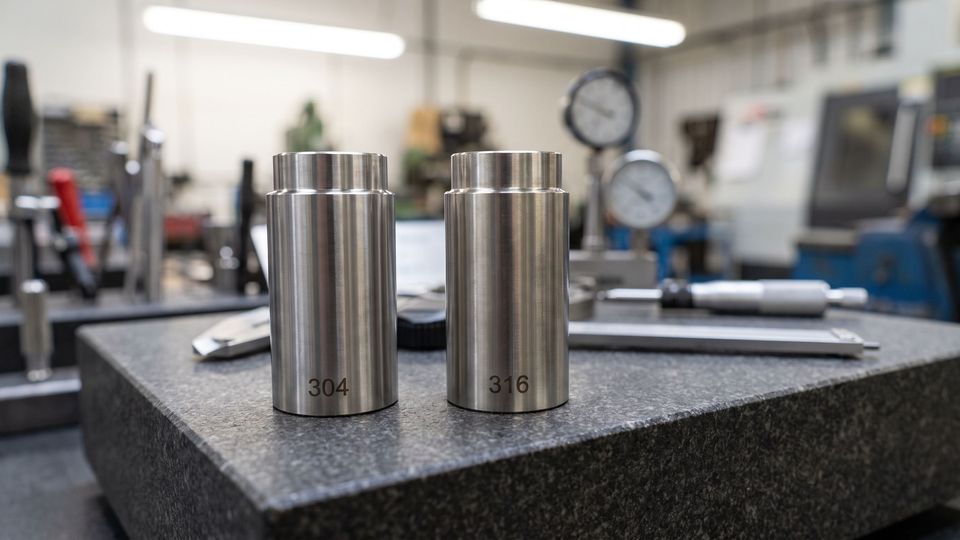
The difference between 304 and 316 stainless steel comes down to one element: molybdenum. Grade 316 contains 2 to 3% of it, 304 contains none, and that addition gives 316 far better resistance to chlorides, salt and aggressive chemicals. It also makes 316 typically 20 to 30% more expensive.
That is the short answer. The more useful question is which grade your part actually needs, and this is where we see money wasted in both directions.
We machine both grades every week at our stainless steel machining facility in Leighton Buzzard, from 316 vessel lids for pharmaceutical clients to 304 brackets and housings for general engineering. This comparison covers what the specification sheets say, and what two decades at the machine have taught us about choosing between them.
The Quick Comparison
| 304 | 316 | |
|---|---|---|
| EN designation | 1.4301 | 1.4401 (316L: 1.4404) |
| Chromium | 17.5 to 19.5% | 16.5 to 18.5% |
| Nickel | 8 to 10.5% | 10 to 13% |
| Molybdenum | None | 2 to 3% |
| Chloride resistance | Moderate | Good |
| Relative cost | Baseline | Typically 20 to 30% more |
| Magnetic? | No (slightly, after cold work) | No (slightly, after cold work) |
| Typical uses | Food equipment, general engineering, architecture | Marine, medical, pharmaceutical, chemical processing |
If you are working from a UK or European drawing, look for the EN numbers rather than the American grade names. A drawing calling for 1.4301 wants 304, and 1.4404 means 316L.
What the Molybdenum Actually Does
Molybdenum protects the steel against pitting and crevice corrosion in chloride environments. Salt water, road salt, chlorinated cleaning chemicals and many process fluids attack stainless steel through tiny localised pits rather than uniform surface rust, and molybdenum is what stops that mechanism.
Metallurgists quantify this with the Pitting Resistance Equivalent Number (PREN). Grade 304 sits around 19, while 316 reaches roughly 24 to 26, a meaningful step up in chloride environments.
Away from chlorides, the two grades behave very similarly. Both form the same self-healing chromium oxide layer, both handle everyday moisture and atmospheric corrosion without complaint, and they are indistinguishable by eye.
When 304 Is Enough
Here is the honest advice that saves our customers money: most parts specified in 316 could be machined in 304 with no difference in service life.
304 is the right choice when your part lives indoors or in a normal atmospheric environment, sees no salt or chloride exposure, and is not subject to aggressive washdown chemicals. Brackets, housings, fixtures, shafts, food-contact parts in dry or low-salt applications, and architectural components all sit comfortably in 304.
The 20 to 30% material saving is not the only benefit. 304 is marginally kinder to machine, which shows up in cycle times and tooling cost on larger batches.
If a competitor quotes you 316 without asking where the part will be used, they have not thought about your job. The environment decides the grade, not habit.
When You Genuinely Need 316
Some applications are not negotiable, and speccing 304 to save money in these environments is a false economy that ends in pitted, failed parts.
Choose 316 (or 316L) when the part will see any of the following:
- Salt: marine hardware, coastal installations, anything near road gritting
- Chlorinated chemicals: washdown regimes in pharmaceutical and food production, swimming pool plant, cleaning-in-place systems
- Process chemistry: acids, brines and solvent exposure in chemical and process equipment
- Medical and hygienic duty: surgical instruments and medical device components where repeated sterilisation is routine
- High-chloride water: brackish or softened water systems, as opposed to standard UK potable water where 304 generally performs well
The pharmaceutical vessel lids and stirrers in our portfolio are all 316 or 316L. Nobody in that industry debates the premium, because a pitted product-contact surface is a contamination risk, not just a cosmetic problem.
How They Machine
This is the part most comparison articles skip, because most of them are written by stockholders rather than machinists.
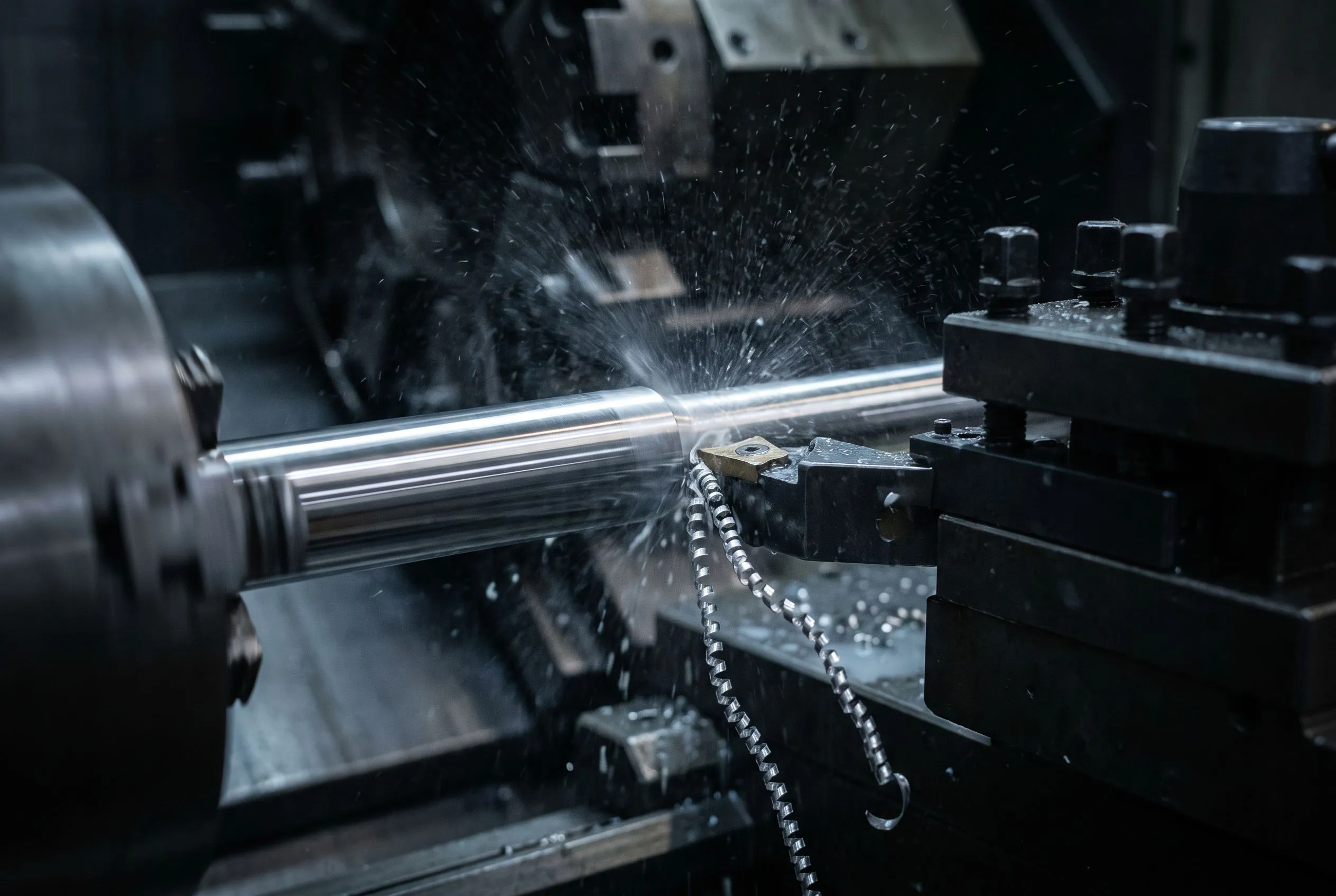
Both grades are austenitic and both work-harden aggressively. If a cutting tool rubs instead of cutting, the surface hardens under it and the next pass has a worse job to do, so sharp tooling, positive engagement and consistent feeds matter more than they do on mild steel.
316 is the tougher of the two at the spindle. The higher nickel and molybdenum content makes it gummier, with long stringy swarf, higher cutting pressures and faster insert wear, so we run it slightly slower than 304 and watch tool life more closely.
Neither grade is difficult by our standards, and we hold ±0.01mm on both. But on a large batch the difference shows up in cycle time and tooling spend, which is one more reason not to spec 316 out of habit.
Worth knowing: if your part has no meaningful corrosion exposure at all and volume matters, grade 303 is the free-machining member of the family. The added sulphur transforms machinability at the cost of corrosion resistance, and for internal components it is often the smartest choice of the three.
316 vs 316L
The L stands for low carbon, with 316L held below 0.03% carbon against roughly 0.08% for standard 316.
The difference matters when parts are welded. During welding, carbon can combine with chromium at the grain boundaries and locally strip the steel of its corrosion protection, a problem called sensitisation, and the low-carbon grade avoids it.
For machined-from-solid components the distinction is minor, and much of the bar stock sold in the UK is dual-certified 316/316L anyway. Pharmaceutical and medical drawings typically specify 316L as standard practice.
How to Tell 304 and 316 Apart
You cannot tell them apart by looking, and this catches people out because mixed stock is visually identical.
There are three reliable routes. The mill certificate that came with the material states the grade and heat number, a PMI test (positive material identification, usually a handheld XRF gun) reads the alloy composition in seconds, and molybdenum spot-test kits give a quick chemical yes or no for 316.
This is why material traceability matters in regulated work. Every bar that enters our workshop keeps its certificate and batch number from goods-in to finished part, so the question never arises after the event.
What About the Price Difference?
Expect 316 bar to cost roughly 20 to 30% more than the equivalent 304 section, driven by the nickel and molybdenum content.
Both grades float with alloy surcharges, so the gap moves month to month with the nickel market. On a machined component the material is only part of the price, so the finished-part difference is usually smaller than the raw material difference, particularly on complex parts where machining time dominates.
For current market context, the British Stainless Steel Association publishes guidance on grades and their applications.
Choosing in 30 Seconds
Ask three questions about the part’s working life:
- Will it see salt, chlorides or aggressive cleaning chemicals? If yes, 316.
- Is it welded and used in a corrosive environment? If yes, 316L.
- Neither of the above? 304 will almost certainly serve, at a lower price.
Still unsure? Send us the drawing and tell us where the part lives. Material selection advice costs nothing with your quote, and we would rather machine the right grade than the expensive one.
Frequently Asked Questions
Is 316 stainless steel better than 304?
Only in chloride and chemical environments. 316 resists pitting from salt and aggressive chemicals far better than 304, but in a dry indoor application both grades will last indefinitely, and 304 does the job at 20 to 30% less cost.
What are the disadvantages of 316 stainless steel?
Cost is the main one, typically 20 to 30% over 304. It is also slightly tougher to machine, which adds cycle time and tooling wear on production batches. Neither matters if the environment genuinely demands 316.
Are 304 and 316 stainless steel magnetic?
Neither grade is magnetic in the annealed condition. Both can become slightly magnetic after cold working such as bending or rolling, which surprises people testing parts with a magnet. A magnet is not a reliable way to identify either grade.
Can I use 304 stainless steel outdoors?
Yes, in most inland UK environments 304 performs well outdoors. Within a few miles of the coast, or anywhere exposed to road salt spray, specify 316 instead, as chloride pitting will eventually stain and pit a 304 surface.
Is 304 or 316 better for food applications?
Both are food safe and widely used. 304 covers most food equipment, while 316 is preferred where salty or acidic products and chlorinated cleaning regimes are involved, which is why much dairy and brewing plant specifies it.