
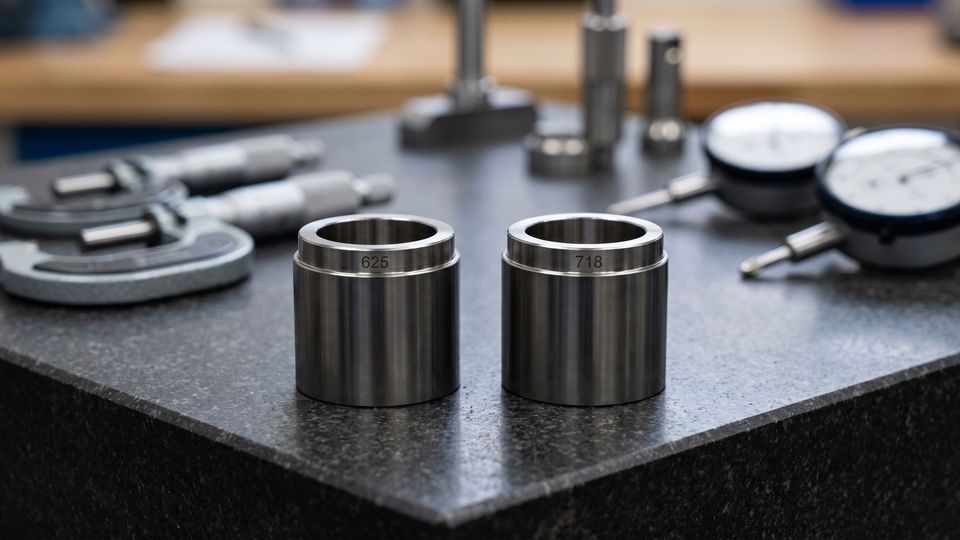
Choosing between Inconel 625 and 718 comes down to one question: is your enemy corrosion or load? Grade 625 offers the better chemical and seawater resistance with excellent weldability, while age-hardened 718 is roughly twice as strong and dominates high-stress, high-temperature applications like gas turbine components.
Both are nickel super alloys, both punish cutting tools, and both cost several times what stainless steel does. The differences that matter live in how they gain their strength, where they survive, and what they are like to machine.
We machine both grades at our Inconel machining facility in Leighton Buzzard, for aerospace, motorsport and process industry clients. Here is the comparison from the metallurgy down to the machine spindle.
The Quick Comparison
| Inconel 625 | Inconel 718 | |
|---|---|---|
| UNS / W.Nr | N06625 / 2.4856 | N07718 / 2.4668 |
| Strengthening | Solution strengthened (Mo + Nb) | Precipitation (age) hardened |
| Typical tensile strength | 830 to 930 MPa annealed | 1,240 MPa+ aged |
| Typical yield strength | Around 415 to 490 MPa | Around 1,035 MPa+ |
| Best corrosion resistance | Seawater, acids, chlorides | Moderate, still far above stainless |
| Useful temperature ceiling | Oxidation resistance towards 980°C | High strength maintained to about 650°C |
| Weldability | Excellent | Good, unusually so for an age-hardened alloy |
| Typical uses | Subsea, chemical processing, exhausts | Turbine discs, aerospace structures, fasteners |
The strength gap is the headline. Aged 718 yields at roughly twice the stress that annealed 625 does, which is why the two alloys rarely compete for the same job once the requirements are written down.
How Each Alloy Gets Its Strength
Grade 625 is strengthened by molybdenum and niobium atoms sitting in the nickel-chromium matrix. The strength is built in at the mill, needs no heat treatment, and holds steady across a wide temperature range.
Grade 718 works differently. In the solution-treated state it is relatively soft, then an ageing treatment at around 720°C precipitates fine particles through the structure that block deformation, roughly doubling its strength.
That mechanism sets 718’s temperature ceiling. Above about 650°C the strengthening particles begin to coarsen and the advantage fades, while 625 soldiers on at higher temperatures where oxidation resistance matters more than outright strength.
Where 625 Earns Its Keep on Corrosion
With more chromium and far more molybdenum than 718, grade 625 shrugs off seawater, brines, acids and chloride pitting. It is the default nickel alloy for subsea hardware and aggressive chemical processing for exactly this reason.
718 is no slouch against corrosion, comfortably outperforming stainless steels. But if the environment is the main threat rather than the load, 625 is usually the right answer, and its excellent weldability makes it the easier alloy to fabricate into assemblies.
Machining 625 vs 718 at the Spindle
This is where the stockholder comparison articles go quiet, because the two alloys behave quite differently under a cutting tool.
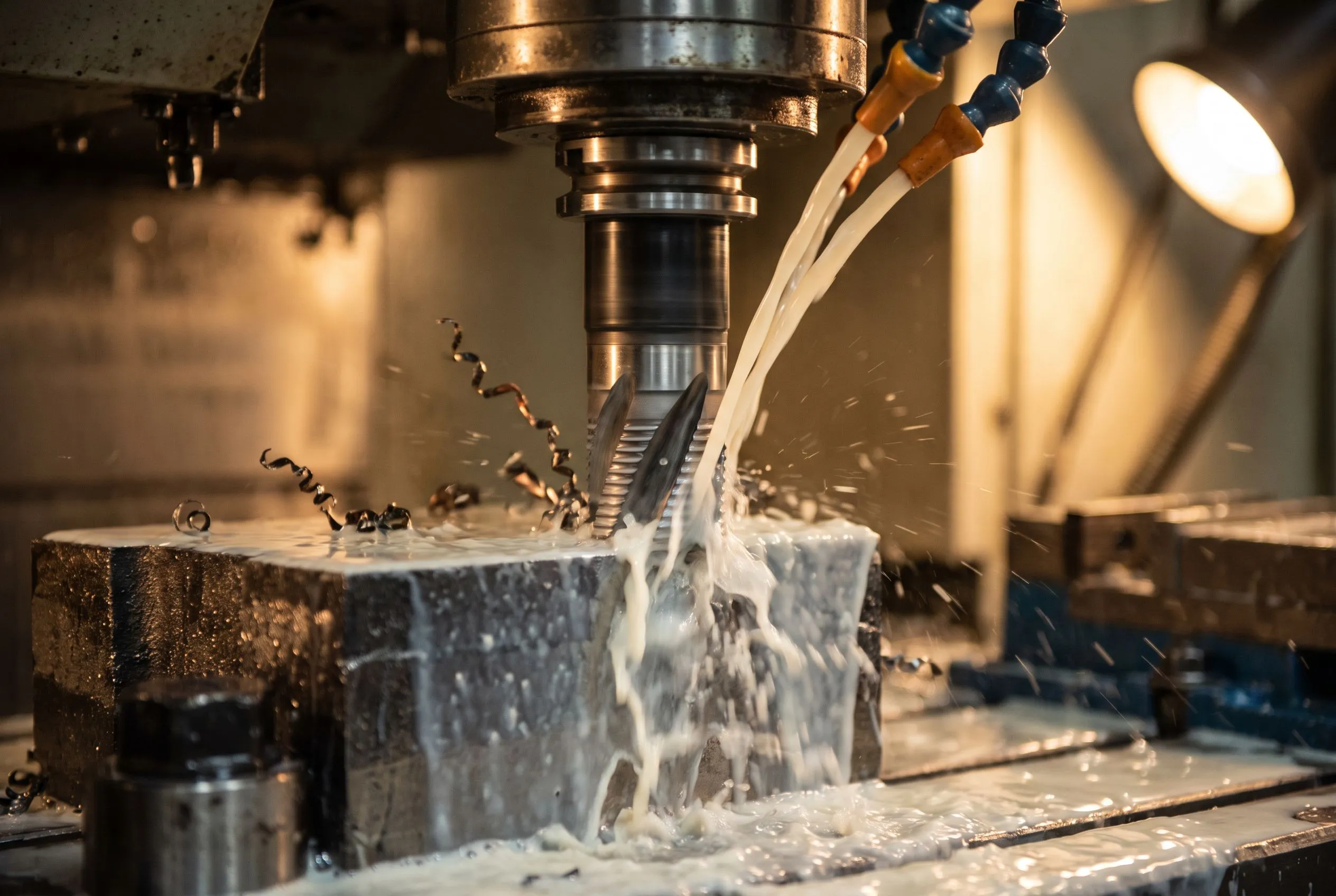
Annealed 625 is the gummier of the two. It work-hardens viciously, drags long stringy chips across the insert and generates intense heat at the cutting edge, so everything depends on sharp tooling, positive cuts and never letting the tool dwell.
718 is usually machined after solution treatment, or partly in the aged condition for the best dimensional stability. Aged 718 is harder on tools in absolute terms, but its chips break more cleanly and the material feels more predictable at the spindle, particularly on finishing passes where 625 wants to smear.
Both alloys run at a fraction of the cutting speeds of stainless steel, with high-pressure coolant and rigid workholding non-negotiable. We routinely hold ±0.01mm on both, CMM verified, but cycle times and tooling budgets are in a different league from conventional materials, which feeds directly into what these parts cost.
The same disciplines carry across to machining Hastelloy, where we cover coolant strategy and cutting data in more depth.
One practical note on 718: machine it in the wrong condition and the ageing treatment afterwards will move your dimensions. Sequencing machining and heat treatment correctly is part of quoting the job properly.
Choosing Between Them
The decision usually writes itself once two questions are answered:
- What is the operating temperature? Sustained load-bearing above roughly 650°C rules out aged 718’s strength advantage. Below it, 718’s extra strength is available if needed.
- Is the environment chemically aggressive? Seawater, acids and chloride-rich process fluids favour 625. Clean but heavily loaded environments favour 718.
In practice that maps to: 625 for subsea, chemical plant, exhaust systems and heat shields; 718 for turbine discs and blades, aerospace structural parts, high-strength fasteners and downhole tooling that works hard mechanically.
For aerospace and defence work the drawing usually specifies the grade and condition outright. Where we add value is in motorsport and process industries, where the choice is sometimes still open and the cheaper-to-machine option can be worth a conversation.
For a peer-reviewed comparison of the two alloys’ properties, this ScienceDirect review covers the mechanical data in depth.
Cost and Availability
Both alloys sit at the expensive end of the bar rack, at several times the price of stainless steel, and both move with the nickel market. Prices per kilogram are broadly similar between the two grades, so the finished-part cost difference usually comes from machining time and any heat treatment rather than the material itself.
Availability in UK bar stock is good for both in common diameters. Less common sizes are worth checking early, because super alloy lead times from mills can stretch when demand from aerospace spikes.
Getting Inconel Parts Machined
Whichever grade your application needs, the machining partner matters more with these alloys than almost any other material, because the difference between a shop that knows them and one that does not shows up in price, lead time and scrapped parts.
Send us your drawings and the operating conditions, and we will confirm the grade makes sense before quoting. Both alloys are machined here with full material traceability and CMM inspection as standard.