
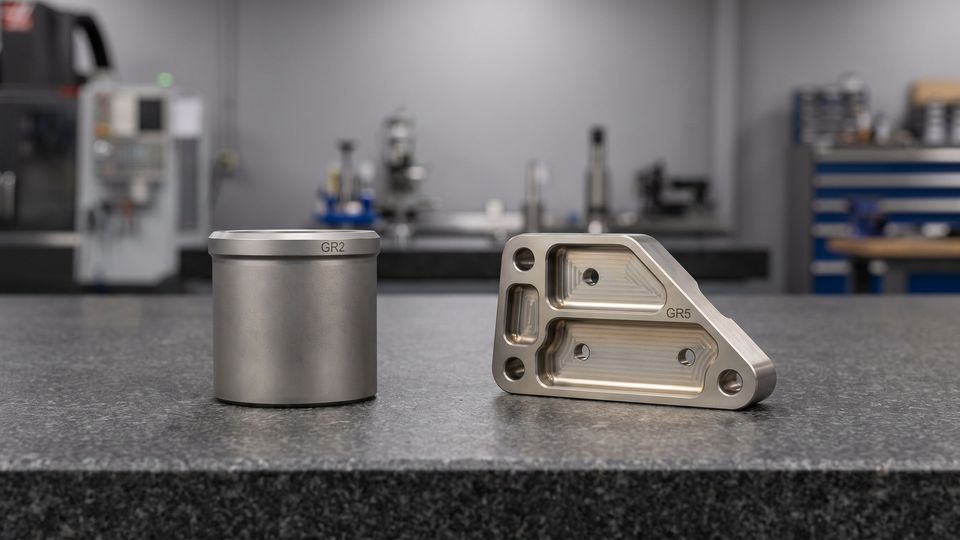
Titanium Grade 2 is the corrosion and formability grade. Grade 5 is the strength grade.
Grade 5 (Ti-6Al-4V) has roughly two and a half times the strength of Grade 2, which makes it the default for loaded aerospace, motorsport and fastener parts. Grade 2 is commercially pure titanium, softer and easier to weld, and the usual choice where corrosion matters more than load.
Most comparison articles stop at the datasheet. The differences that drive the price of a machined part show up at the cutting edge, and that is where this comparison spends most of its time.
We machine both grades, along with Grade 23 for medical work, at our titanium machining workshop in Leighton Buzzard. Every property figure below comes from the published ASTM B348 bar minimums or standard reference data, so the numbers can be checked.
The Quick Comparison
| Grade 2 | Grade 5 (Ti-6Al-4V) | |
|---|---|---|
| UNS / W.Nr | R50400 / 3.7035 | R56400 / 3.7165 |
| Type | Commercially pure, alpha | Alloy, alpha-beta |
| Min tensile strength (ASTM B348) | 345 MPa | 895 MPa |
| Min yield strength (ASTM B348) | 275 MPa | 828 MPa |
| Min elongation | 20% | 10% |
| Typical hardness | About 160 HB | About 334 HB |
| Density | 4.51 g/cm³ | 4.43 g/cm³ |
| Thermal conductivity | About 16 W/m·K | About 6.7 W/m·K |
| Elastic modulus | About 105 GPa | About 114 GPa |
| Weldability | Excellent | Good, with more care |
| Typical uses | Chemical plant, heat exchangers, marine fittings | Aerospace structures, fasteners, motorsport, medical |
The strength gap is the headline: Grade 5’s minimum yield is three times Grade 2’s.
The figure that matters most for machining is further down. Grade 5 conducts heat at well under half the rate of Grade 2, and that one property explains most of the difference in cycle time and tooling cost.
What Makes Them Different
Grade 2 is unalloyed titanium with small, controlled amounts of oxygen and iron. Its strength comes from those interstitial elements, so it is soft and ductile, and it forms and welds easily.
Grade 5 adds about 6% aluminium and 4% vanadium. The aluminium strengthens the alpha phase and the vanadium stabilises a second beta phase, giving an alpha-beta alloy that can also be heat treated for extra strength.
Grade 5 is also very slightly lighter, at 4.43 g/cm³ against 4.51 g/cm³. That gap is too small to matter on its own, but it means the strength gain comes with no weight penalty at all.
Is Grade 5 Titanium Stronger Than Steel?
Grade 5 is stronger than most steels used for machined parts, at a little over half the density. Its 895 MPa minimum tensile strength comfortably exceeds 316 stainless at about 515 MPa and matches EN24T in the T condition at 850 to 1,000 MPa.
Grade 2 is a different story. At 345 MPa minimum, it is weaker than 316 stainless and closer to mild steel, so it is chosen for what it resists rather than what it carries.
That is why the two grades rarely compete for the same part once the loads are written down. If a part carries real load, the conversation is almost always about Grade 5.
Corrosion Resistance
Both grades form a stable oxide film that makes them effectively immune to seawater, chlorides and most oxidising environments. For general marine and outdoor use, either grade will outlast stainless steel.
The difference shows up in aggressive process chemistry. In hot chloride and acid streams, commercially pure grades are the usual specification, with palladium-bearing Grade 7 used where Grade 2 is not quite enough.
Grade 5 still has excellent corrosion resistance. It is simply not chosen for chemical plant, because the extra strength is rarely needed there and Grade 2 is easier to fabricate into vessels, tube plates and welded assemblies.
Machining Grade 2 vs Grade 5 at the Spindle
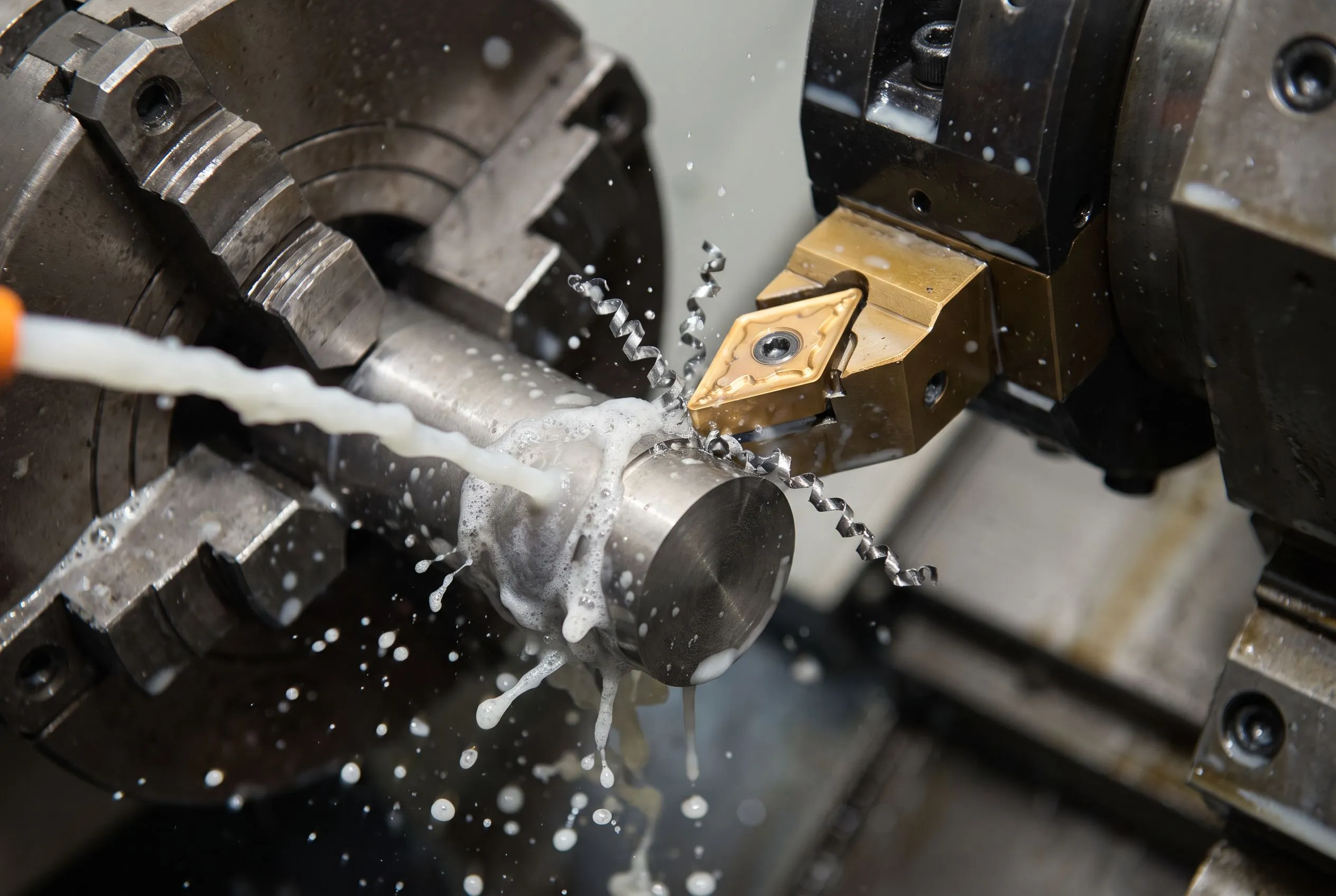
Grade 5 is the harder grade to machine in terms of tool life and cutting speed, because heat stays at the cutting edge instead of leaving with the chip. Grade 2 runs faster and is kinder to tools, but its gummy chips and built-up edge cause their own problems.
Grade 5 and the heat problem
At about 6.7 W/m·K, Grade 5 barely conducts heat. Most of the energy of the cut ends up in the tool tip, which softens the carbide and wears the edge quickly.
The response is lower cutting speeds, sharp coated carbide and high-pressure coolant aimed right at the cutting zone. Chips form in segments and break more readily than Grade 2’s, which helps on deep features.
Grade 2 and the gummy problem
Grade 2 is soft and ductile, so it tends to smear rather than shear cleanly. It produces long, stringy chips that wrap around tools and can weld to the cutting edge as built-up edge, tearing the surface finish.
The fix is positive, sharp geometry, good chip breaking and plenty of coolant. Grade 2 also holds a burr more readily than Grade 5, so deburring adds time that a quote should allow for.
What both grades share
Both have a low elastic modulus, around half that of steel. Thin walls and long slender features spring away from the tool and chatter, so workholding and toolpath strategy matter as much as the material itself.
Both also work-harden if a tool rubs instead of cutting. Letting a tool dwell in titanium is the quickest way to ruin an edge and the part’s surface.
We hold ±0.01mm on critical titanium dimensions, verified on a CMM, in both grades. The same principles of heat and chip control apply to nickel alloys, which we cover in our Inconel 625 vs 718 comparison.
Cost of Grade 2 vs Grade 5 Parts
A Grade 5 part almost always costs more than the same geometry in Grade 2. The bar normally costs more per kilogram, and slower cutting speeds plus faster tool wear add machine time on top.
Size, certification and order quantity move the material price more than the grade itself, so treat any per-kilogram comparison as a rough guide. The bigger driver on most parts is machine time, as explained in our guide to UK CNC machining costs.
One thing catches buyers out. If a part needs Grade 5’s strength and is redesigned in Grade 2 to save money, the thicker sections needed to carry the load often cancel the saving and add weight.
In UK stock, Grade 5 is the most widely held titanium bar because aerospace demand keeps it moving. Grade 2 is common in sheet, plate and tube, so check availability early if you need a less common Grade 2 bar diameter.
Where Grade 23 Fits for Medical Parts
Grade 23 is Ti-6Al-4V ELI, the extra-low-interstitial version of Grade 5. Oxygen is limited to 0.13% against 0.20% for Grade 5, and iron to 0.25% against 0.40%.
Those tighter limits give better ductility and fracture toughness for a small drop in strength. ASTM B348 sets Grade 23 bar at 828 MPa minimum tensile and 759 MPa minimum yield.
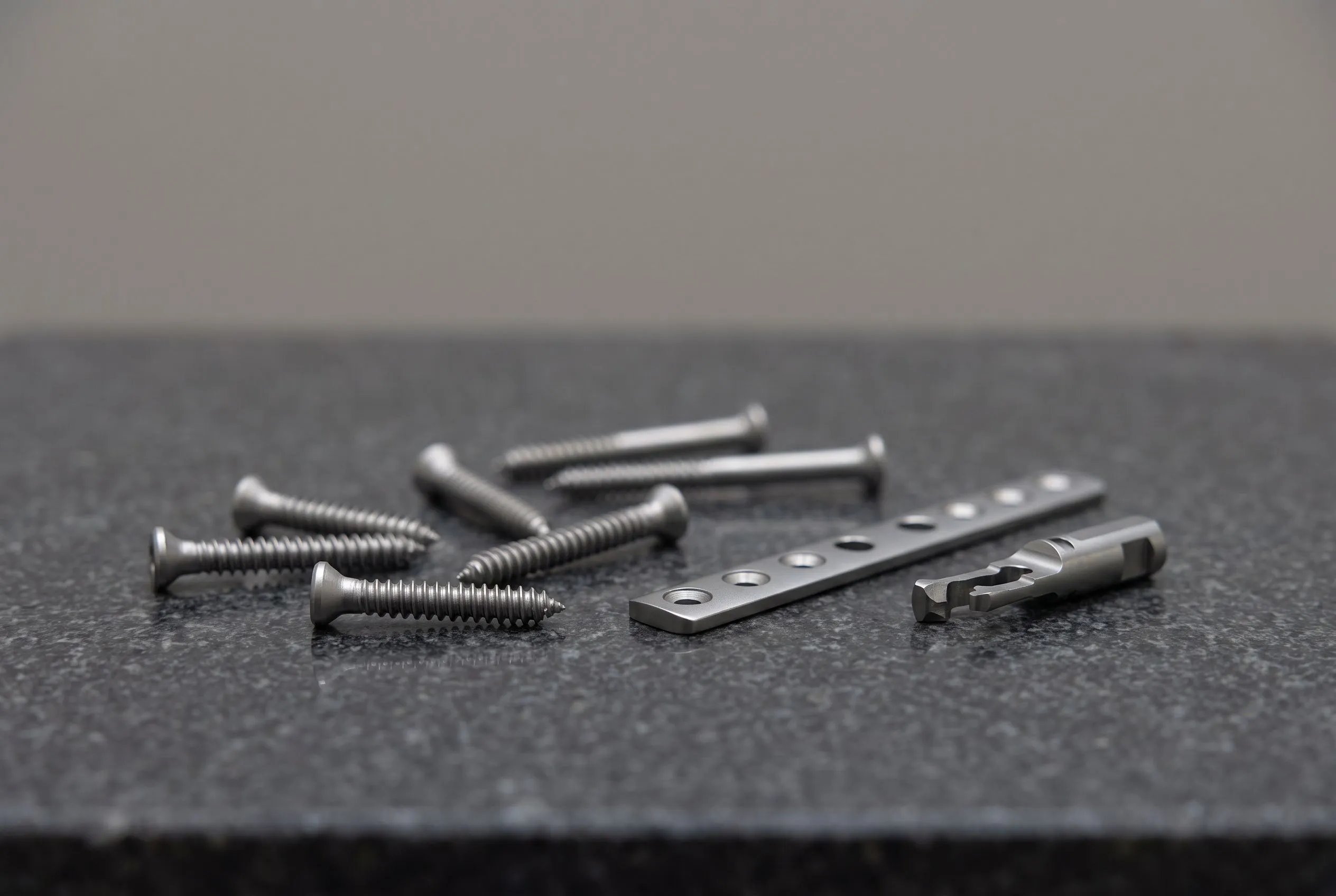
For surgical implants, Grade 23 is supplied to ASTM F136, which sets 860 MPa minimum tensile and 795 MPa minimum yield for bar from 4.75mm up to 44.45mm diameter. Titanium Industries’ Grade 23 data covers the full specification.
Commercially pure titanium has its own implant standard, ASTM F67, and Grade 5 for medical use is covered by ASTM F1472. On medical device work the drawing and the device maker’s specification decide the grade, and our job is to machine it and keep the material certificates traceable to every part.
Choosing Between Them
Three questions settle most decisions:
- Does the part carry significant load? If yes, Grade 5. Grade 2’s 275 MPa minimum yield rules it out of most structural, fastener and rotating parts.
- Is the environment chemically aggressive? Hot chlorides, acids and process fluids favour Grade 2 or a palladium grade, especially where the part is welded.
- Will it be formed or welded after machining? Grade 2 bends and welds far more easily, which matters for fabricated assemblies.
In practice that maps to Grade 5 for aerospace and defence structures and fasteners, motorsport uprights, brackets and bolts, and medical instruments. Grade 2 goes to heat exchanger parts, chemical plant fittings, marine hardware and anything that will be welded into a larger assembly.
Whichever grade you specify, state the standard on the drawing, usually ASTM B348 for bar, and ask for a 3.1 certificate. Our guide to EN 10204 material certificates explains what each certificate type proves.
Getting Titanium Parts Machined
Send us your drawings with the grade, the standard and the operating conditions. If the grade looks wrong for the job, we will say so before quoting, because it is cheaper to change a drawing than to scrap a batch.
Both grades are machined here with full material traceability from goods-in to finished part and CMM inspection on critical dimensions.
Frequently Asked Questions
Is Grade 2 or Grade 5 titanium better?
Neither is better across the board. Grade 5 (Ti-6Al-4V) is about two and a half times stronger and much harder, so it suits loaded aerospace, motorsport and fastener parts. Grade 2 is softer, more ductile, easier to weld and form, and the usual choice for chemical plant, heat exchangers and marine fittings where corrosion matters more than strength.
Is Ti-6Al-4V the same as Grade 5 titanium?
Yes. Ti-6Al-4V is the composition (roughly 6% aluminium and 4% vanadium) and Grade 5 is its ASTM designation, with UNS number R56400 and W.Nr 3.7165. Grade 23 is the extra-low-interstitial version of the same alloy, sold as Ti-6Al-4V ELI, with tighter oxygen and iron limits.
Is Grade 5 titanium stronger than steel?
Stronger than most steels used for machined parts. Grade 5 bar has a minimum tensile strength of 895 MPa, against roughly 515 MPa for 316 stainless and about 850 to 1,000 MPa for EN24T. It matches EN24T at around 57% of the weight, which is why it replaces steel wherever mass matters.
Is Grade 5 titanium harder to machine than Grade 2?
Yes, in terms of tool life and cutting speed. Grade 5 conducts heat at less than half the rate of Grade 2, so heat builds at the cutting edge and tools wear faster. Grade 2 runs faster but is gummy, producing long stringy chips and built-up edge, so it is not an easy material either.
What is the difference between Grade 5 and Grade 23 titanium?
Grade 23 is Ti-6Al-4V with lower interstitial limits: 0.13% oxygen maximum against 0.20% for Grade 5, and 0.25% iron against 0.40%. That gives better ductility and fracture toughness for slightly lower strength. Grade 23 to ASTM F136 is the standard titanium alloy for surgical implants.